Hounslow Council Far Behind Net Zero Targets
Several environmental policies to tackle climate emergency have stalled
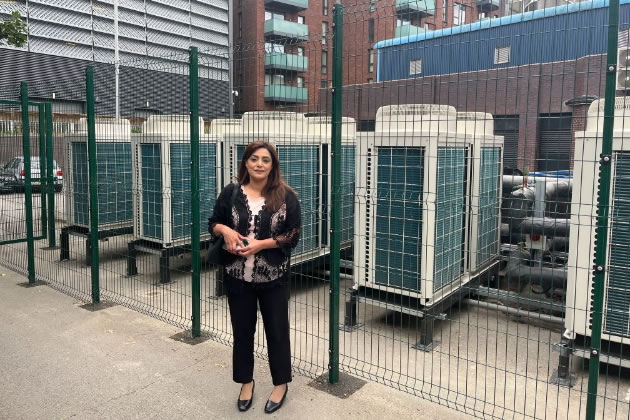
Cllr Samia Chaudhary with heat pumps installed by the council. Picture: Hounslow Council
November 9, 2026
Hounslow Council’s Net Zero 2030 ambitions are in jeopardy as several of its environmental policies have stalled or fallen behind schedule.
The council declared a climate emergency in 2019 and adopted a climate action emergency plan five years later. However, just one year on from its “refreshed” action plan, 80 per cent of these policies are off track.
At the highest risk of non-delivery is Hounslow’s pledge to decarbonise the council’s entire operational estate. This includes replacing inefficient gas boilers with heat pumps, installing solar panels and installing energy efficacy measures.
However, just one of the council’s 37 buildings has been decarbonised, with this section of the project rated “high risk” because “the funding required to deliver decarbonisation of council operations to achieve net zero by 2030 is significant and not currently identified or available.” A further 29 assets have been partially decarbonised, and seven have not been decarbonised at all.
Hounslow also committed to decarbonising 16,000 council managed social homes by 2030. However, progress stalled this year, with only 150 homes fully decarbonised, and no further homes decarbonised in 2026.
To meet this 2030 target, the council would have to undertake work on over 5,200 homes a year – council documents indicate ”limited further progress” is anticipated in 2027.
According to the council, the focus has been on incorporating the housing portfolio and net zero neighbourhoods pilot into the Strategic Energy Partnership and preparing for the Warm Homes Plan which will “facilitate a programme of place based retrofit.”
Despite falling behind on housing, the council says it is on track to decarbonise all schools by 2030, despite only fully decarbonising one school in 2026. The council says it will “continue to replace fossil fuel heating systems to increase number of fully and partly decarbonised schools.”
The local authority outlined an objective to transition away from fossil fuel powered to ultra-low emission vehicles in its fleet. The council owns 492 vehicles, of which 359 are diesel or petrol powered, and 133 are hybrid or zero emission.
When adopting policies to transition to cleaner energy, the council viewed Hydrotreated Vegetable Oil (HVO) as an alternative for diesel whilst waiting for battery charging infrastructure to develop. However, in 2026, zero transitions were undertaken, and electric vehicles account for just 2.2 per cent of the fleet.
On vehicles, Hounslow committed to install 2,000 electric vehicles charging points by 2026 – this failed. As such, the council has halved the target and extended the deadline to 1,000 charging points by 2030.
The council says the target was not achieved due to procurement delays and resourcing challenges. Feasibility studies have identified that to meet the strategic aim (residents without off-street parking being within a 30 second walk of a charging point), around 1,000 lamp column charging points will be required.
Despite most objectives stalling, the council rated reducing emissions from employee business travel as on track. This target will be achieved through development and implementation of a formal policy in consultation with staff and members on vehicle hires.
The council has set out a number of key deliverables planned for the next 12 months to try and get net zero by 2030 back on track. This includes the complete decarbonisation projects on five leisure centres, Hanworth Air Park, Isleworth Public Hall and Cranford Library.
The council will also install HVO infrastructure at its Bridge Road Depot and Spacewaye Civic Amenity site, in addition to replacing end of life internal combustion vehicles with ultra-low emissions vehicles.
Philip James Lynch - Local Democracy Reporter
Like Reading Articles Like This? Help Us Produce More This site remains committed to providing local community news and public interest journalism. Articles such as the one above are integral to what we do. We aim to feature as much as possible on local societies, charities based in the area, fundraising efforts by residents, community-based initiatives and even helping people find missing pets. We’ve always done that and won’t be changing, in fact we’d like to do more. However, the readership that these stories generates is often below that needed to cover the cost of producing them. Our financial resources are limited and the local media environment is intensely competitive so there is a constraint on what we can do. We are therefore asking our readers to consider offering financial support to these efforts. Any money given will help support community and public interest news and the expansion of our coverage in this area. A suggested monthly payment is £8 but we would be grateful for any amount for instance if you think this site offers the equivalent value of a subscription to a daily printed newspaper you may wish to consider £20 per month. If neither of these amounts is suitable for you then contact info@neighbournet.com and we can set up an alternative. All payments are made through a secure web site. One-off donations are also appreciated. Choose The Amount You Wish To Contribute. If you do support us in this way we’d be interested to hear what kind of articles you would like to see more of on the site – send your suggestions to the editor. For businesses we offer the chance to be a corporate sponsor of community content on the site. For £30 plus VAT per month you will be the designated sponsor of at least one article a month with your logo appearing if supplied. If there is a specific community group or initiative you’d like to support we can make sure your sponsorship is featured on related content for a one off payment of £50 plus VAT. All payments are made through a secure web site. |