Continued Overspend Increases Pressure on Hounslow's Budget
Rising social care costs leave little room for manoeuvre on tax rates
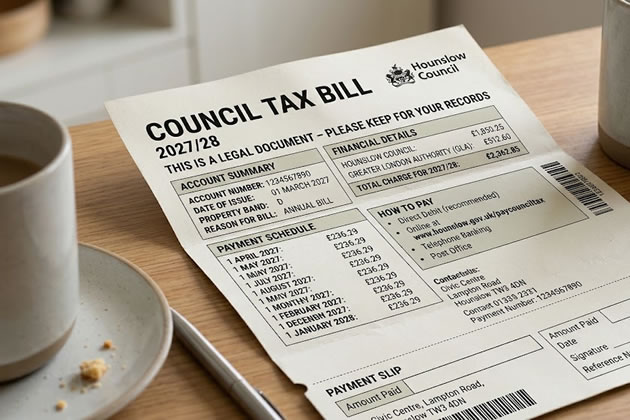 Residents might need to brace for another 4.99% rise next year. Picture: AI generated
November 3, 2026
A report into Hounslow Council’s finances due to be presented to the Cabinet suggests there is little room for error in the borough’s budget and points to another maximum tax rise being announced next year.
The monitoring report for the latest quarter (Quarter 2) points to a deteriorating position since the summer. The report, due before Cabinet on Tuesday 10 November, forecasts an £8.0m overspend on the General Fund largely driven by increasing social care costs for adults and children. That is £5.2m worse than the previous quarter, and it would be met from risk reserves if it isn't clawed back. The report doesn't mention council tax for 2027/28, but the numbers in it will shape the budget set in February and March.
The council has been under strain for some time. Its 2024/25 year ended with a General Fund overspend of £14.8m, which forced an unplanned drawdown from reserves. In July 2025 it was projecting a recurrent gap of £51.5m for 2026/27, rising to £91.3m by 2028/29. The 2026/27 budget closed that gap with roughly £26m of savings, an extra £21.3m from local government funding changes and a business rates reset, and the maximum 4.99% council tax rise, which took Band D to £1,675.05 (£2,185.56 including the GLA precept). Council leader Shantanu Rajawat said the extra government money and the council tax uplift were both needed even after the savings, and that skipping the rise would have a material impact on services.
The most recent full-year result was better than feared. The 2025/26 outturn was a £1.6m General Fund overspend, £5.2m better than the £6.8m directorate overspend reported for the third quarter. Cabinet Member for Finance Cllr Max Mosley credited an 84% savings hit rate and lower temporary accommodation costs. Several London boroughs, by contrast, needed exceptional financial support from government in 2025/26, something Hounslow has avoided so far.
This year's problems are concentrated in social care. Children and Adult Services is forecasting a £7.4m overspend, the biggest single driver. Children's placements and looked-after-children costs account for £2.3m, and Children with Disabilities adds £1.6m, with average domiciliary care packages rising from £77k to £92k. Adult social care adds £1.3m, with domiciliary care and nursing numbers running above the budget model, and the Social Care Academy adds £1.0m. Strategy and Transformation (+£2.5m) and Wellbeing, Environment and Commissioning (+£2.4m) are also over budget, mainly because of slipped income and savings, parking, and waste contract costs. The main offset is Placemaking and Growth, which is £3.2m under budget because lower temporary accommodation demand produces a £5.1m underspend in Housing Services. That underspend is itself demand-driven and could reverse.
Savings delivery is the second problem. Of the £31.1m General Fund programme, which includes a £5.0m contingency, £19.89m is delivered or on track, roughly two-thirds, compared with the 84% hit rate cited for last year. A further £6.74m has slipped to 2027/28 and £0.80m is judged undeliverable. Together those exceed the contingency by £2.54m, which feeds directly into the overspend. The delay matters beyond this year, because savings pushed into 2027/28 still have to be found on top of that year's own budget gap. Some of the slippage is genuine timing, such as the Bedfont Lane children's home and localised planning fee changes. The demand growth in Children with Disabilities and adult social care is harder to reverse, and officers are still assessing whether the adult care trend is temporary or permanent.
Reserves are where the strain shows. If the overspend stands, total revenue reserves fall from £125.5m to £106.1m, with risk reserves dropping from £20.9m to £12.1m while general balances stay at £18.0m. The Chief Financial Officer says the position strains resilience and will introduce additional spending controls. In February the council's finance chief had already warned that reserves cannot be relied upon indefinitely to plug structural gaps.
Schools finance is better than it looks, but only because of a one-off. The High Needs Block is forecast to overspend by £5.4m, which would have taken the accumulated Dedicated Schools Grant deficit to £21.4m by March 2027. A provisional £15.3m High Needs Stability Grant, linked to approval of the council's SEND reform plan, brings it down to £6.1m. It isn't yet confirmed whether future support will continue at 90% of the cumulative deficit. Maintained schools are forecast to end the year with an aggregate deficit of around £6m, an improvement on the £8.5m expected earlier but still a concern.
All of this feeds into council tax, which Full Council normally sets in late February or early March on a recommendation from Cabinet. The arithmetic leaves little room. The 2026/27 council tax requirement is £158.437m, so each 1% raises an estimated £1.6m, and a 4.99% rise would raise roughly £7.9m before any growth in the tax base. That is about the size of this year's forecast overspend. Whether the overspend recurs is the key question, but a council facing recurring pressures and slipped savings will find it hard to forgo that income.
National policy also pushes towards the maximum. Government funding projections assume councils levy the maximum permitted 4.99% each year, and the limit has been lifted for 2027/28 and 2028/29 only for a handful of authorities with historically low council tax, such as Westminster and Wandsworth. Hounslow isn't among them. The limit for 2027/28 should be confirmed in the provisional settlement, usually published in December.
Collection is also weakening. In-year Council Tax collection stands at 53.59% against a 54.55% target, a gap that has widened by 0.63 percentage points since Quarter 1, and Council Tax Support caseloads are edging up. The 2026/27 budget assumed a 98.25% collection rate, up from 98.0%, and any Collection Fund deficit lands in next year's budget. Business rates are also behind target, by 1.42 points.
Against that, affordability is a real constraint. Hounslow's Band D bill passed £2,000 for the first time this year, though the council notes its own element is below the Outer London average. The Conservative opposition has argued the administration's plans mean rises of more than 15% over three years. The scale of the 2027/28 gap is not yet public.
The report seems to point to another maximum increase being the most likely outcome. The council took that route for 2026/27 and in recent years, national funding assumptions are built on it, and the Quarter 2 position makes forgoing it hard. A 4.99% rise would add roughly £84 to the council's element of Band D, taking it to about £1,759 before the GLA precept.
Several things could shift that picture. A better-than-forecast outturn is possible, since last year's Quarter 3 position improved by £5.2m by year-end, and a generous settlement or confirmed multi-year Dedicated Schools Grant support would ease the gap. Further demand pressure in children's and adult social care, the high-needs grant not continuing, or weaker council tax collection would make the arithmetic harder. Residents and councillors will want to watch the next quarterly finance monitoring report, the provisional settlement in December, the council tax base and Collection Fund position in January, and the Cabinet budget papers in February. Those will set out the actual gap and the proposed rise.
Like Reading Articles Like This? Help Us Produce More This site remains committed to providing local community news and public interest journalism. Articles such as the one above are integral to what we do. We aim to feature as much as possible on local societies, charities based in the area, fundraising efforts by residents, community-based initiatives and even helping people find missing pets. We've always done that and won't be changing, in fact we'd like to do more. However, the readership that these stories generates is often below that needed to cover the cost of producing them. Our financial resources are limited and the local media environment is intensely competitive so there is a constraint on what we can do. We are therefore asking our readers to consider offering financial support to these efforts. Any money given will help support community and public interest news and the expansion of our coverage in this area. A suggested monthly payment is £8 but we would be grateful for any amount for instance if you think this site offers the equivalent value of a subscription to a daily printed newspaper you may wish to consider £20 per month. If neither of these amounts is suitable for you then contact info@neighbournet.com and we can set up an alternative. All payments are made through a secure web site. One-off donations are also appreciated. Choose The Amount You Wish To Contribute. If you do support us in this way we'd be interested to hear what kind of articles you would like to see more of on the site – send your suggestions to the editor. For businesses we offer the chance to be a corporate sponsor of community content on the site. For £30 plus VAT per month you will be the designated sponsor of at least one article a month with your logo appearing if supplied. If there is a specific community group or initiative you'd like to support we can make sure your sponsorship is featured on related content for a one off payment of £50 plus VAT. All payments are made through a secure web site. |