Ealing Moves to Bottom of the Food Hygiene Score Table
Council says low ratings due to robust enforcement and complex local market
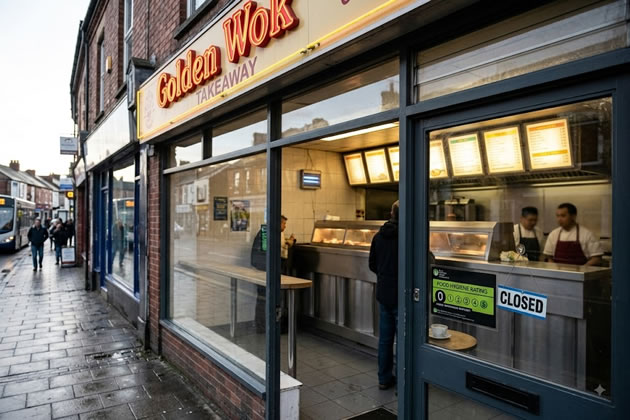
A higher proportion of takeaways in the borough might account for the low average score
. Picture: AI Generated
August 11, 2026
Ealing has found itself at the bottom of London’s food hygiene rankings, continuing a pattern of low scores that has persisted for nearly a decade. The borough’s average score of 3.91 places at the very bottom of the table in 2026 for the thirty London boroughs included.
This represents a further decline from second last place for when the same data was analysed in 2025. This year’s Food Standards Agency data, which was collated by High Speed Training, show a slight decrease from last year and far below the London average of 4.39. The borough of Ealing has a long term tradition of low hygiene ratings. As far back as 2017, the borough was identified as one of the worst-performing areas in the UK, with more than a quarter of restaurants and cafés rated 0, 1 or 2.
The question, inevitably, is why Ealing continues to record low scores year after year. The answer is more complicated than a simple narrative of failing businesses or lax standards. In fact, the council argues the opposite: that Ealing’s consistently low average is a reflection of the borough’s unusually large, diverse and complex food sector, combined with a deliberately tough inspection regime.
Ealing has one of the biggest food economies in London, with more than 3,500 premises—far more than boroughs whose food sectors consist mainly of restaurants and takeaways. Alongside its cafés, corner shops and independent eateries, Ealing has significant numbers of approved food establishments, manufacturers, importers and exporters. This mix creates a regulatory landscape that is far more demanding than in boroughs dominated by high‑street chains or uniform restaurant clusters.
The borough’s food scene is also characterised by high turnover and a large proportion of independent businesses. More takeaways, more small operators, fewer chains: the very qualities that give Ealing its distinctive local flavour also increase the likelihood of variable standards. Chains tend to have centralised compliance systems, dedicated training budgets and corporate oversight. Independent businesses often operate on tight margins, with limited staff capacity and less formalised food safety management. In a borough where independents dominate, the risk of inconsistent hygiene practices naturally rises.
Ealing Council insists that its inspection regime is not only robust but intentionally uncompromising. In the past year alone, officers completed 1,988 inspections and interventions, delivering 97 per cent of the planned programme. Enforcement has been significant: 61 emergency closures, 16 successful prosecutions, more than £300,000 in fines and around £95,000 in costs awarded to the council. These figures suggest a regulatory environment that is stricter than many others in London, and stricter enforcement inevitably produces more low scores.
The council’s spokesperson emphasises that the majority of businesses still achieve ratings of three or above, and overall compliance remains strong at 88 per cent—consistent with previous years. But the sheer size of the sector means that even a small percentage of poorly performing businesses translates into high raw numbers. In the national analysis published in March, Ealing recorded 34 zero‑rated premises, 119 rated one, and 190 rated two. More than 13 per cent of inspected businesses fell into the lowest categories, the second‑highest proportion in the country.
Individual cases, such as the zero rating given to Wenzel’s bakery near Ealing Broadway after a mice infestation, reinforce public concern. But they also highlight the council’s willingness to issue the lowest possible score when serious failings are found. “We will not hesitate to give a low rating if it is justified,” the council says, adding that businesses who persistently fail to operate safely “face tough action.”
Ealing’s challenge is therefore twofold: a complex, fast‑moving food sector with many small operators, and an inspection team that applies the Food Hygiene Rating Scheme with notable rigour. The borough’s consistently low average does not necessarily indicate declining standards; rather, it reflects the scale of the task and the council’s determination to enforce compliance.
The Food Standards Agency has acknowledged Ealing’s commitment to enforcement, and the council points to targeted support as part of its strategy. Officers carried out 125 advisory visits last year, helping 28 businesses improve their rating. Window stickers are issued to all premises, and residents are encouraged to check ratings online and question any business that does not display its score.
Across London, hygiene standards have improved slightly over the past year, and boroughs such as Lewisham and Bromley have made notable gains. Kensington and Chelsea continues to lead the region with an average score of 4.81. Ealing, however, remains at the bottom of the table. Whether future years will see improvement depends on whether the borough’s independent-heavy food sector can keep pace with the demands of a stringent regulatory environment—and whether the council’s mix of enforcement and support can shift long‑standing patterns.
Like Reading Articles Like This? Help Us Produce More This site remains committed to providing local community news and public interest journalism. Articles such as the one above are integral to what we do. We aim to feature as much as possible on local societies, charities based in the area, fundraising efforts by residents, community-based initiatives and even helping people find missing pets. We've always done that and won't be changing, in fact we'd like to do more. However, the readership that these stories generates is often below that needed to cover the cost of producing them. Our financial resources are limited and the local media environment is intensely competitive so there is a constraint on what we can do. We are therefore asking our readers to consider offering financial support to these efforts. Any money given will help support community and public interest news and the expansion of our coverage in this area. A suggested monthly payment is £8 but we would be grateful for any amount for instance if you think this site offers the equivalent value of a subscription to a daily printed newspaper you may wish to consider £20 per month. If neither of these amounts is suitable for you then contact info@neighbournet.com and we can set up an alternative. All payments are made through a secure web site. One-off donations are also appreciated. Choose The Amount You Wish To Contribute. If you do support us in this way we'd be interested to hear what kind of articles you would like to see more of on the site – send your suggestions to the editor. For businesses we offer the chance to be a corporate sponsor of community content on the site. For £30 plus VAT per month you will be the designated sponsor of at least one article a month with your logo appearing if supplied. If there is a specific community group or initiative you'd like to support we can make sure your sponsorship is featured on related content for a one off payment of £50 plus VAT. All payments are made through a secure web site. |