Call for Action to Protect Hay Fever Sufferers on the High Road
Shedding season for London Planes causing discomfort for many
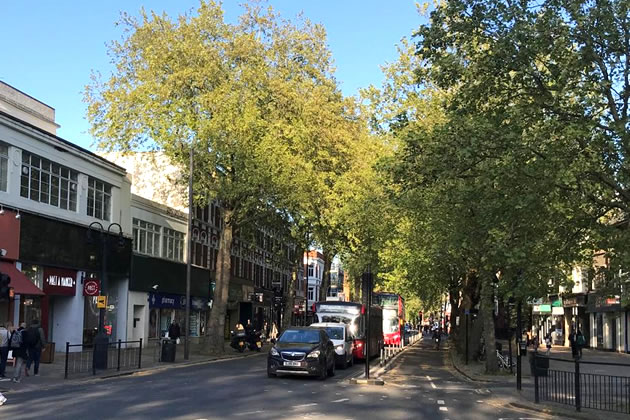
The canopy of trees along the High Road is currently shedding pollen and fibres
April 22, 2026
Each spring, Chiswick's trees shed a cloud of pollen and microscopic fibres that leave residents coughing, sneezing and rubbing their eyes. This year, local councillors are demanding action to reduce the impact particular on those who already suffer from hay fever.
The magnificent London plane trees lining the High Road — a species which accounts for roughly a fifth of all street trees in London — are in the midst of their annual shedding season. From mid-March through to early summer, they release two distinct waves of irritants: allergenic pollen first, followed by a shower of trichomes, the tiny, hooked, hair-like fibres that coat their young leaves and seed pods.
It is the trichomes — sometimes compared to microscopic itching powder — that cause perhaps the more insidious problem. Unlike pollen, which triggers a conventional immune response, these stiff fibres are a purely mechanical irritant, scratching their way into the respiratory tract and eyes of even perfectly healthy people. The phenomenon is well enough known among Londoners to have earned its own name: the "Chelsea Cough."
The three Conservative candidates for Chiswick Gunnersbury ward — Joanna Biddolph, Ron Mushiso and Vickram Grewal — have written formally to Hounslow Council's cabinet member for street cleaning, Cllr Shivraj Grewal, demanding that mechanical road sweepers be urgently deployed along Chiswick High Road.
Their request is specific: a thorough sweep, ideally late at night when the road is clear of traffic, using vacuum-based mechanical equipment rather than brush sweepers, which risk redistributing the fine particles rather than removing them. Workers, they say, should be provided with protective clothing and masks. The operation should then be repeated daily until the shedding season is over.
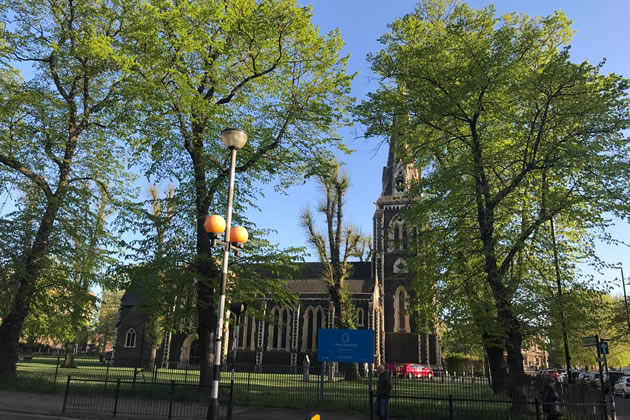
London planes make up a high proportion of the trees on Chiswick High Road
The case for acting promptly is not merely one of comfort. The pollen and trichomes that collect in gutters, along pavement edges and in the cycle lane become a secondary source of airborne irritants whenever disturbed — by passing vehicles, cyclists, pedestrians, or a brisk spring wind. The longer the material sits, the more opportunities there are for it to be re-suspended in the air people are breathing.
"It's about minimising the effect it might have and ensuring that Chiswick High Road is as pleasant and enjoyable as it is possible to be, even during this annual occurrence," the three councillors said in a joint statement.
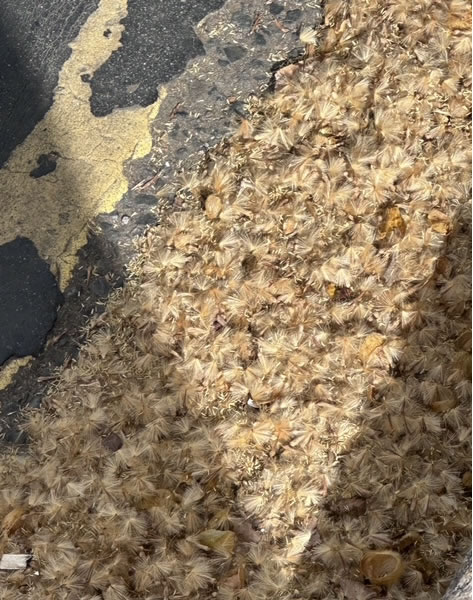
Tree seeds deposited on Chiswick High Road
The High Road's traders — and in particular those who work outdoors, such as fruit, vegetable and flower stall holders — are exposed to the irritants throughout the working day. The councillors note that local businesses are already navigating a difficult economic climate, and anything that deters shoppers from venturing onto the High Road represents a further unwelcome pressure.
Cllr Peter Thompson, leader of the Conservative group on Hounslow Council, has said that, if the measures are adopted, the party would ensure mechanical sweeping is formally programmed into the street cleaning schedule every year going forward. "It can't be avoided," he acknowledged, "and I feel particularly badly for residents with hay fever and for our traders, such as our flower and fruit and veg stall holders, who have to work outside in it all day long."
Asked for its response, Hounslow Council said it currently sweeps Chiswick High Road weekly with a heavy mechanical sweeper, and is exploring whether this can be increased to three times a week during the shedding season.
The council also noted that London plane trees are no longer pruned once they are in full leaf — typically by the end of April — in order to avoid dislodging seed pods and trichomes. It acknowledged, however, that natural shedding on windy days cannot be prevented.
The London plane's dominance on the capital's streets is no accident. Introduced centuries ago, the species thrives in urban conditions, famously shedding its bark — and, with it, accumulated soot and pollution — to keep its surface clean. Mature specimens are among the most effective carbon-sequestering trees available to city planners: a single large plane is said to provide the cooling equivalent of ten air conditioning units, making them a significant tool against the urban heat island effect.
Recognising this, organisations such as Transport for London are now applying a "10-20-30" rule to new tree planting — stipulating that no single species should account for more than ten per cent of the urban canopy — which will, over time, dilute the concentration of plane tree irritants in any given area.
| Chiswick Gunnersbury Candidates | |
|---|---|
Name |
Party |
Joanna Biddolph |
Conservative |
Aubrey Mark Charles Crawley |
Green Party |
Guy de Boursac |
Liberal Democrats |
Jon Elkon |
Green Party |
Vickram Grewal |
Conservative |
Paul Jonathan Halliwell |
Liberal Democrats |
Nik Hole |
Liberal Democrats |
Hanif Ahmad Khan |
Labour |
Ron Mushiso |
Conservative |
Sau Khuan Parkins |
Reform UK |
Maria Saroya |
Labour |
Joshua Stanton |
Reform UK |
Naeem Ulfat |
Labour |
Leanne Yu |
Reform UK |
Like Reading Articles Like This? Help Us Produce More This site remains committed to providing local community news and public interest journalism. Articles such as the one above are integral to what we do. We aim to feature as much as possible on local societies, charities based in the area, fundraising efforts by residents, community-based initiatives and even helping people find missing pets. We’ve always done that and won’t be changing, in fact we’d like to do more. However, the readership that these stories generates is often below that needed to cover the cost of producing them. Our financial resources are limited and the local media environment is intensely competitive so there is a constraint on what we can do. We are therefore asking our readers to consider offering financial support to these efforts. Any money given will help support community and public interest news and the expansion of our coverage in this area. A suggested monthly payment is £8 but we would be grateful for any amount for instance if you think this site offers the equivalent value of a subscription to a daily printed newspaper you may wish to consider £20 per month. If neither of these amounts is suitable for you then contact info@neighbournet.com and we can set up an alternative. All payments are made through a secure web site. One-off donations are also appreciated. Choose The Amount You Wish To Contribute. If you do support us in this way we’d be interested to hear what kind of articles you would like to see more of on the site – send your suggestions to the editor. For businesses we offer the chance to be a corporate sponsor of community content on the site. For £30 plus VAT per month you will be the designated sponsor of at least one article a month with your logo appearing if supplied. If there is a specific community group or initiative you’d like to support we can make sure your sponsorship is featured on related content for a one off payment of £50 plus VAT. All payments are made through a secure web site. |