Unstaffed Chiswick Library Could Have Longer Opening Hours
Council's new 'self-access' model would see CCTV monitoring installed
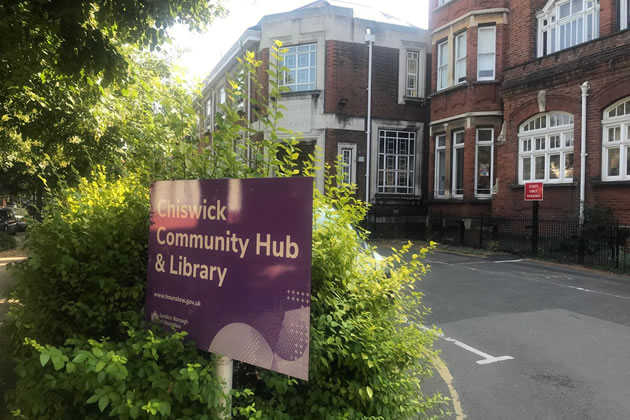
Chiswick Library
July 8, 2026
Chiswick Library is among 11 Community Hubs and Libraries across the London Borough of Hounslow set to be transformed under a new "self-access" operating model. The proposal, which is due to go before Cabinet on 14 July, forms part of a wider £1.2 million capital investment programme, would see registered library members able to enter and use the building during extended hours when no staff are present, monitored instead by CCTV.
The plan follows the Council's transformation earlier this year of its libraries into "Community Hubs and Libraries" under its Localities model. The next phase, now going to Cabinet, aims to modernise facilities and introduce self-service technology so that libraries can open for longer without a corresponding increase in staffing costs. Under the model, each site will retain some conventional hours, staffed and open to all, alongside new self-access hours, during which only registered members with a library card can enter. During these unstaffed periods, buildings will be remotely monitored by CCTV, with security and health and safety arrangements to be confirmed through site-by-site risk assessments.
According to the outline design tables in the business case, Chiswick Library currently offers 53 hours of opening a week, all of it staffed, across six days. Under the new model, this would change to 37 hours of staffed opening and 43 hours of self-access opening, giving a total of 80 hours a week, an increase of 27 hours, or roughly 51 per cent, on current provision, with staffed days remaining at six per week. Chiswick residents would be able to use the library for far longer than today, including at times when the building currently sits closed. Across all 11 sites, the Council estimates self-access could increase total opening hours borough-wide by as much as 80 per cent, adding up to 19,000 extra hours of library access every year.
The additional 27 hours of access are being delivered not by adding staff, but by removing the need for staff to be present at all for a large share of the extended opening period. This pattern repeats across nearly every site in the report. Most locations see their total hours rise sharply, many to a common ceiling of 80 hours a week, while staffed hours generally fall or stay flat, with the difference made up entirely by unstaffed, self-access time.

Chiswick Library
This is significant because the report's own financial case rests on the model delivering a net, recurring saving of £405,000 a year against the existing Libraries budget by the end of 2028/29, and states plainly that a proportion of the savings is expected to be delivered through workforce efficiencies, such as careful vacancy management, natural staff turnover and reducing the use of temporary or agency workers. At Chiswick and elsewhere, the staffed offer, the version of the service where a librarian or community hub advisor is present to help, supervise and support, is shrinking rather than growing.
Chiswick is one of the busier sites in the borough's network, and one of several libraries, alongside Feltham, Heston and Hounslow, operating at the 80-hour ceiling and staffed across six days a week under both the current and proposed arrangements. For residents who rely on staff for help, whether navigating digital services, accessing quiet study space, or simply feeling safe using a public building, this means a smaller window in which that support is guaranteed to be available. The extra 43 hours a week of self-access time will suit some users well, particularly those wanting flexible access for study or quiet use outside typical hours, but it will not replace the staffed experience for those who need it.
The report is candid about several risks associated with the shift to unstaffed hours generally, even if it doesn't connect them explicitly to reduced staffing levels. It acknowledges that buildings without onsite staff supervision may pose risks to both people and assets, requiring robust, site-specific risk assessments and consideration of insurance implications. It also notes that changes to working patterns, shift schedules and potentially job descriptions will need careful management, in consultation with trade unions, with the Council committing to phase in changes and use temporary contracts to protect permanent roles wherever possible. And it identifies resident opposition, including concerns about safety or reduced staff availability, as a risk to the project's delivery and the Council's reputation, to be managed through engagement and communications.
Assuming Cabinet approves the proposal on 14 July, an engagement period will run from summer through autumn 2026, giving Chiswick residents, staff and stakeholders the opportunity to feed back on how the model should be tailored locally, including, potentially, the balance between staffed and self-access hours. Building and technology upgrades are expected to begin from January 2027, with self-access going live at the first sites from April 2027, and a wider rollout continuing through to September 2027. Chiswick's final hours, and the specific mix of staffed versus self-access time, are described in the report as indicative, subject to refinement based on the outcomes of engagement, site risk assessments and design work through to November 2026.
Like Reading Articles Like This? Help Us Produce More This site remains committed to providing local community news and public interest journalism. Articles such as the one above are integral to what we do. We aim to feature as much as possible on local societies, charities based in the area, fundraising efforts by residents, community-based initiatives and even helping people find missing pets. We’ve always done that and won’t be changing, in fact we’d like to do more. However, the readership that these stories generates is often below that needed to cover the cost of producing them. Our financial resources are limited and the local media environment is intensely competitive so there is a constraint on what we can do. We are therefore asking our readers to consider offering financial support to these efforts. Any money given will help support community and public interest news and the expansion of our coverage in this area. A suggested monthly payment is £8 but we would be grateful for any amount for instance if you think this site offers the equivalent value of a subscription to a daily printed newspaper you may wish to consider £20 per month. If neither of these amounts is suitable for you then contact info@neighbournet.com and we can set up an alternative. All payments are made through a secure web site. One-off donations are also appreciated. Choose The Amount You Wish To Contribute. If you do support us in this way we’d be interested to hear what kind of articles you would like to see more of on the site – send your suggestions to the editor. For businesses we offer the chance to be a corporate sponsor of community content on the site. For £30 plus VAT per month you will be the designated sponsor of at least one article a month with your logo appearing if supplied. If there is a specific community group or initiative you’d like to support we can make sure your sponsorship is featured on related content for a one off payment of £50 plus VAT. All payments are made through a secure web site. |