TfL's Bollo Lane Buildings to Meet Passivhaus Standard
Redesign of Phase Three aims to make scheme more sustainable
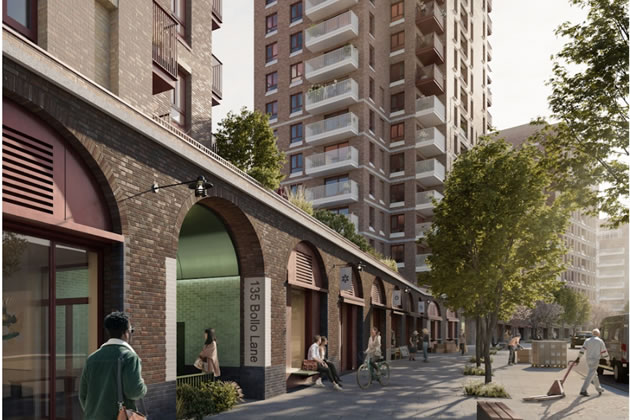
A visualisation of part of Phase 3 of the Bollo Lane development. Picture: Allies and Morrison
December 18, 2025
Amendments to the design of part of Transport for London’s massive development project, which aim to make it more sustainable, have been submitted to Ealing Council.
Architects Allies and Morrison conducted a Passivhaus feasibility study with consultants, Beyond Carbon, on the third phase of the scheme which revealed the five towers in this part could achieve Passivhaus performance through minor adjustments. A supplementary planning application is now underway to take the scheme forward as Passivhaus.
The development is currently being managed by Bollo Lane LLP, a joint venture between Places for London (TfL’s property company) and Barratt London.
Phase 3 contains a total of 457 flats in five buildings up to 18 storey high, with a commitment to 50% affordable housing (by habitable room). They will be built on top of the brick arches on Bollo Lane along the existing curve of the track for 750 metres.
Construction is expect to begin on this phase in February 2026. The earliest possible date for completion of the first two phases in March 2029 with the third phase likely to be some time after than.
Two taller towers bookend mansion blocks with workspaces and commercial premises occupying the arched colonnade below.
The transition from a standard building design to the Passivhaus standard has necessitated several architectural and mechanical adjustments. These include pivoting to a "fabric-first" design to meet the Passivhaus space heating demand target of 15kWh/m. The documents state that the buildings will generate 86% fewer lifetime emissions compared to standard Building Regulations dwellings. This is estimate to reduce average annual heating and hot water bills in the flats from £800 to £100.
The plan removes the originally consented internal heating substation in Block E and the project will now use individual Exhaust Air Heat Pumps (EAHP) in each home.
The introduction of high-efficiency Mechanical Ventilation with Heat Recovery (MVHR) is another a core component of the new design.
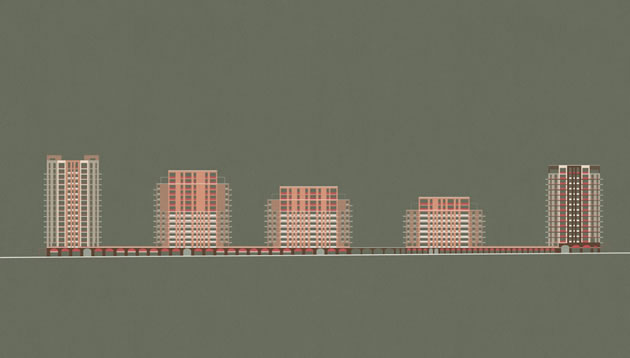
Drawings of the buildings in Phase 3. Picture: Allies and Morrison
To meet the strict thermal requirements of Passivhaus, several "non-material" visual changes are proposed:
There is a reduction in the total glazing area for Blocks C, D, and E to minimize heat loss and new shading canopies are being added to top-level balconies, specifically on the South West elevations, to prevent summertime overheating.
Summary of Key Changes by Block
Feature |
Change Detail |
Affected Blocks |
Heating |
Central substation removed; individual Heat Pumps added. |
Block E (Substation), All (Pumps) |
Cooling |
Addition of solar shading canopies on top floors. |
South West Elevations (C, D, E, F) |
Layout |
Introduction of high-quality duplex apartments. |
Block F |
Commercial |
Cycle store converted to glazed commercial unit. |
Block E (Lower Ground) |
Facade |
Glazing area reduction and half-brick reveals. |
Blocks C, D, E |
Sustainability |
Full Passivhaus Certification target. |
All Phase 3 Units |
To accommodate more insulation, the brick "reveals" (the distance the window sits back from the brick face) are being reduced from a full brick to a half-brick reveal.
Block F has been redesigned to include duplex apartments, leading to an increase in height which was not deemed significant enough to warrant .
In addition a former lower-ground-floor cycle store in Block E is being transformed into a commercial unit with new fully glazed arched openings.
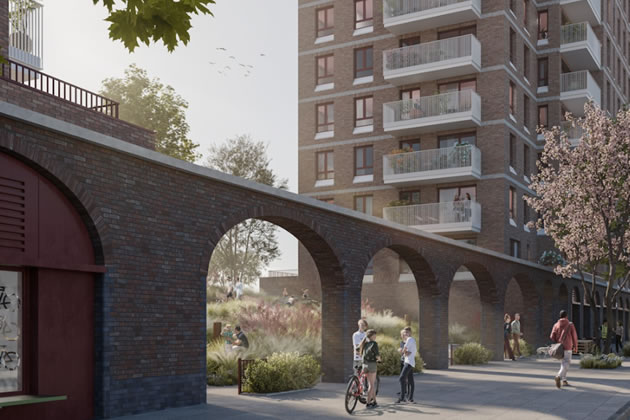
There will be a raised platform for the public spaces around the towers. Picture: Allies and Morrison
By moving to individual heat pumps and Passivhaus standards, TfL and Barratt London aim to effectively "future-proofing" the development against rising energy costs and stricter future environmental regulations.
Like Reading Articles Like This? Help Us Produce More This site remains committed to providing local community news and public interest journalism. Articles such as the one above are integral to what we do. We aim to feature as much as possible on local societies, charities based in the area, fundraising efforts by residents, community-based initiatives and even helping people find missing pets. We’ve always done that and won’t be changing, in fact we’d like to do more. However, the readership that these stories generates is often below that needed to cover the cost of producing them. Our financial resources are limited and the local media environment is intensely competitive so there is a constraint on what we can do. We are therefore asking our readers to consider offering financial support to these efforts. Any money given will help support community and public interest news and the expansion of our coverage in this area. A suggested monthly payment is £8 but we would be grateful for any amount for instance if you think this site offers the equivalent value of a subscription to a daily printed newspaper you may wish to consider £20 per month. If neither of these amounts is suitable for you then contact info@neighbournet.com and we can set up an alternative. All payments are made through a secure web site. One-off donations are also appreciated. Choose The Amount You Wish To Contribute. If you do support us in this way we’d be interested to hear what kind of articles you would like to see more of on the site – send your suggestions to the editor. For businesses we offer the chance to be a corporate sponsor of community content on the site. For £30 plus VAT per month you will be the designated sponsor of at least one article a month with your logo appearing if supplied. If there is a specific community group or initiative you’d like to support we can make sure your sponsorship is featured on related content for a one off payment of £50 plus VAT. All payments are made through a secure web site. |